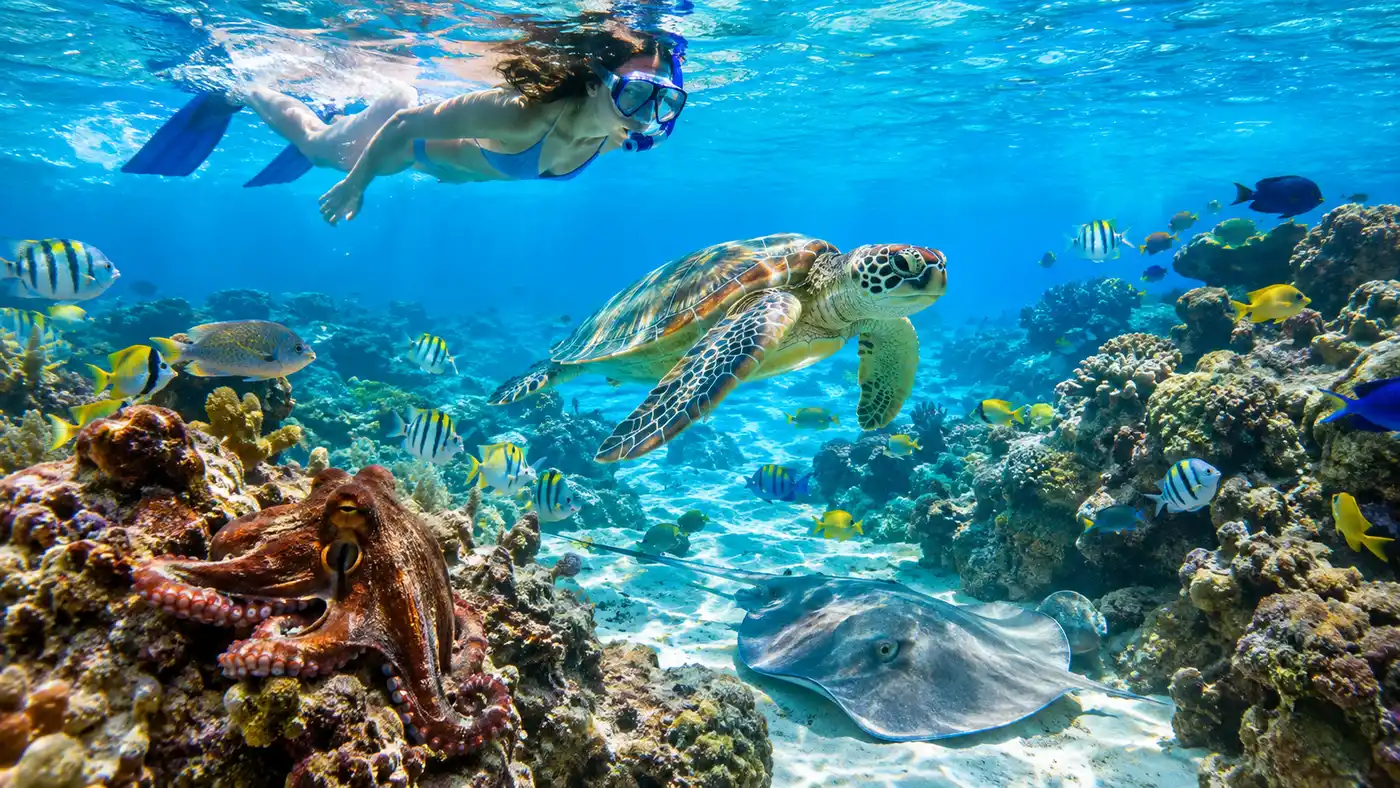
A Guide to St Thomas Marine Life Fish Rays and Octopuses
Dropping your mask into the bay at Secret Harbour or Coki can make your head spin for the first few minutes. Dozens of shapes dart past before your eyes adjust, which is why practicing a bit of st thomas fish identification ahead of time turns a confusing blur into an actual conversation with the reef. You suddenly realize that blue smudge is an adult tang, and the yellow striped thing tailing it is merely looking for leftovers.
The Virgin Islands sit right where Atlantic swells mix into the calm Caribbean basin. That water movement feeds shallow patch reefs, thick seagrass pastures, and deep granite shelves. Every single habitat hosts a different cast of characters. If you know what to look for, you will spot everything from tiny juvenile trunkfish the size of a dice cube up to southern stingrays spanning four feet across.
Book your snorkeling in st thomas experience:
The Common Reef Grazers: St Thomas Fish Identification Basics
Most swimmers meet the grazers first. These are the fish that keep the corals clean by chewing algae off limestone surfaces all day long. Blue tangs are impossible to miss because they travel in roving packs of twenty or thirty, sweeping across shallow coral mounds like an azure broom. When they are young, funny enough, they are bright yellow. They only turn deep blue as they mature, keeping a small, sharp spine right by the base of their tail as defense.
Parrotfish are the loud eaters of the reef. If you float completely motionless above the elkhorn or brain corals, you will hear a distinct scraping sound underwater. That is a stoplight parrotfish using its fused, beak-like teeth to bite directly into rock. They digest the microalgae and grind the rock into fine white sand. A single parrotfish can produce hundreds of pounds of beach sand over its lifespan. Males display bright teal and emerald scales with pink accents, while females look entirely different with brown scales and bright red bellies.
Then you have yellowtail snappers and french grunts hanging suspended in the water column. Grunts congregate in dense schools underneath coral ledges during the daylight hours, facing into the current. They get their name from the raspy sound they make by grinding their pharyngeal teeth together deep inside their throats, an acoustic signal you can occasionally hear if you dive down seven or eight feet.
Look out for these reliable sightings on nearly every shallow snorkel:
- Stoplight parrotfish: Heavy, blunt beak, turquoise body on males, distinct yellow spot near the tail base.
- French grunt: Silver-yellow body with diagonal yellow stripes and bright yellow fins, usually resting under ledges.
- Foureye butterflyfish: Pale white disk with a dark false eyespot near the rear tail to confuse chasing predators.
- Blue tang: Oval pancake shape, vibrant royal blue as adults, sharp defensive scalpel near the tail fin.
- Sergeant major: Five bold black vertical stripes on a yellowish-white flank, fearless around swimmers.
Butterflyfish pair up for life. You will almost never see a foureye butterflyfish alone; their mate is usually swimming three feet away, mirroring every dip and turn into the coral branches.
Mid-Water Hunters: Predatory Fish in St Thomas Waters
Step off the reef crest toward open water and the visual tone shifts. The colors fade from neon yellows to mirrored silvers and deep blues. Great barracudas love this transition zone. People tend to freeze when they see one because a four-foot barracuda looks like an underwater javelin with underhung jaws and visible needle teeth. Honestly, they look terrifying.
They are also intensely curious. A barracuda will often hover motionless ten feet away from your left shoulder, tracking you with its large, glassy eyes. They are rarely aggressive toward swimmers unless someone is spearfishing or wearing flashing silver jewelry that mimics a wounded baitfish. Give them three or four body lengths of space and they simply drift away into the blue haze.
Pro tip: Take off all shiny rings, metal watch bands, and mirrored dive knives before swimming. Predatory fish hunt by spotting silver flashes in murky surf, and clean silicone gear prevents mistaken identity.
Tarpon offer an entirely different rush. These ancient, armored giants gather around docks and calm bays, especially toward late afternoon. At spots like the Charlotte Amalie waterfront or near marina docks, tarpon push six feet in length and weigh over eighty pounds. Their massive scales look like hammered silver dollars, and their mouths angle upward to gulp smaller baitfish from below. Floating alongside a fish that outweighs you is something you do not forget quickly.
Horse-eye jacks and bar jacks patrol these same zones in fast-moving packs. Bar jacks have a striking electric-blue stripe running along their backs, and they frequently shadow stingrays along the bottom. As the ray digs through the sand looking for crabs, the jacks dart in to steal any small shrimp kicked up by the commotion.
| Marine Species | Average Size | Primary Habitat | Common Depth | Temperament |
|---|---|---|---|---|
| Great Barracuda | 2.5 to 4.5 feet | Reef edges, drop-offs | 3 to 25 feet | Curious, territorial |
| Tarpon | 4 to 6 feet | Bays, harbors, mangroves | 5 to 30 feet | Indifferent, calm |
| Southern Stingray | 2 to 4 foot disc | Sandy flats, seagrass | 4 to 18 feet | Docile, bottom-dweller |
| Caribbean Reef Octopus | 1 to 2 feet reach | Rubble fields, crevices | 6 to 20 feet | Extremely shy, elusive |
| Green Sea Turtle | 3 to 4 feet shell | Shallow seagrass pastures | 5 to 15 feet | Gentle grazer |
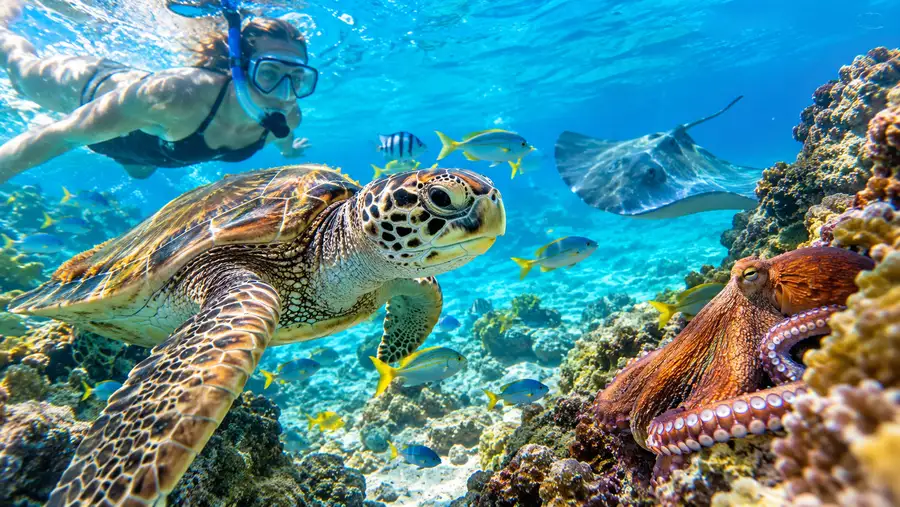
Sand Dwellers: St Thomas Fish Identification on the Bottom
Do not ignore the open sand. Most snorkelers swim straight for the coral formations, completely missing the bizarre life surviving out in the open sunlit desert of the seabed. Southern stingrays spend hours skimming sandy flats, flapping their wing-like pectoral fins to reveal buried mollusks. They leave distinctive craters behind them that look like impact pits.
Note: Southern stingrays bury themselves completely under a fine dusting of sediment with only their breathing spiracles exposed. Shuffle your feet when entering from sandy shorelines to avoid stepping down on one.
Spotted eagle rays are much less common, but they steal the show when they pass. Unlike stingrays, eagle rays rarely rest on the floor. They fly through mid-water with long, pointed wings and a distinct duck-billed snout. Their backs carry a mesmerizing pattern of white rings and dots over midnight-blue skin. You might see two of them gliding in formation across forty feet of water off outer points, moving without apparent effort.
Then you have master camouflage artists like the peacock flounder. If you look closely at what appears to be an empty patch of gravel, an oval outline might shift. Flounders can change their skin pigment in about eight seconds to match surrounding shells and coral rubble. Look for their strange raised periscope eyes and faint electric-blue circles dotting their topside.
Book your snorkeling in st thomas experience:
Masters of Disguise: Octopuses and Invertebrates
Finding a Caribbean reef octopus takes patience and dumb luck. These animals have no rigid skeleton, meaning they can compress an eight-pound body through an opening the diameter of a golf ball. During the day, they wedge themselves deep inside coral caves and pull loose clam shells across the entrance like a makeshift door.
Look for the trash pile. Octopuses leave what divers call an octopus garden right outside their hideouts: a neat, conical mound of cracked crab carapaces, empty conch shells, and white stones. If you spot a pile of fresh shells sitting unnaturally outside a narrow rock crevice, hover there for five minutes. You might see a mottled eye peering back at you from the dark.
If an octopus decides to move while you watch, the show is spectacular. Their skin transforms from smooth chalk-white to bumpy rust-brown in an instant through thousands of tiny pigment cells called chromatophores. They can mimic the texture of rough brain coral or slippery macroalgae. When startled, they pump water through their siphon, shoot a cloud of dark ink to mask their direction, and blast ten yards away in the blink of an eye.
Moray eels share these same rock fractures. Green morays look prehistoric with their thick, muscular bodies and open-jawed breathing posture. The green hue is an optical illusion: their skin is gray, but a layer of yellow mucus covering their body filters the light so they appear bright olive green. Spotted morays are smaller, rarely exceeding three feet, and stay tucked into honeycomb holes with only their spotted heads exposed.
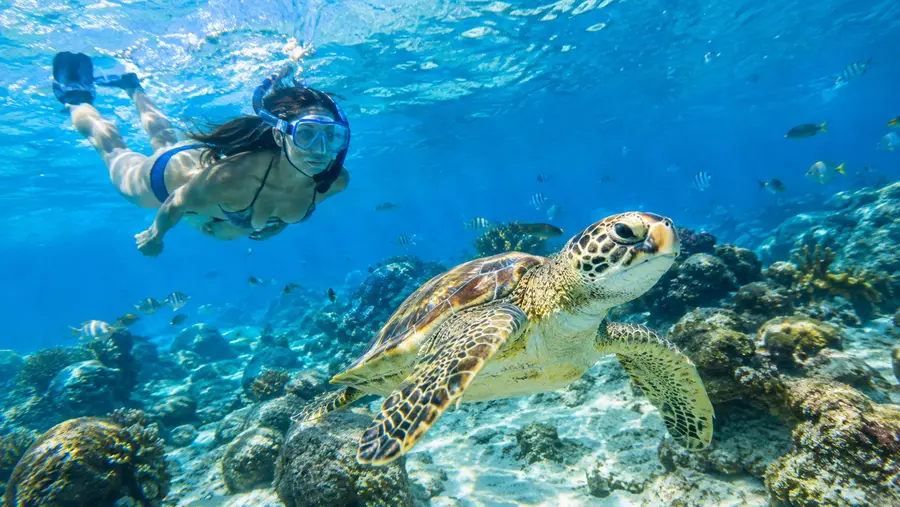
Where to See Sea Turtles in St Thomas and Protect the Reef
Watching a sea turtle surface for air three feet away will make you forget every bad day you have ever had. St Thomas has a thriving population of green sea turtles and hawksbills, thanks to strict federal protection and abundant seagrass beds. Learning where to see sea turtles in st thomas comes down to finding undisturbed grass beds, since green turtles feed almost exclusively on submerged blades of shoal grass and turtle grass.
Hawksbills are smaller and have a narrower, hooked beak designed for pulling toxic sea sponges out of narrow reef cracks. Their shells have overlapping scutes with jagged edges, unlike the smooth, tear-drop carapace of a green turtle. If you visit shallow, clear shorelines like the ones broken down in this Coki Point Beach crystal clear water marine life guide, you might see juveniles feeding right along the edges of the boulder piles.
Be a respectful guest when you encounter them. Human touch strips away protective oils from a turtle's shell, and crowding them can force an animal to stay submerged until it exhausts its oxygen stores. Keep these guidelines in mind whenever you enter their territory:
- Keep distance: Maintain at least ten feet of open space around any sea turtle you spot.
- Never block the surface: Always leave a clear, unobstructed path upward so the animal can breathe without panic.
- Control your fins: Avoid kicking hard over shallow seagrass beds, which churns up silt and ruins their foraging grounds.
- Use mineral sunscreen: Chemical sunscreens contain oxybenzone and octinoxate that bleach corals and poison marine larvae.
The fish in St Thomas depend directly on intact coral networks. Damaging a single head of star coral can wipe out the feeding territory of three generations of damselfish. Float flat, keep your hands tucked near your chest, and let the marine life move around you on its own terms.
Frequently Asked Questions about st thomas fish identification
What is the most common fish seen while snorkeling in St Thomas?
Blue tangs, sergeant majors, and french grunts are seen on almost every swim. Sergeant majors are especially common in shallow water because they are bold and often approach snorkelers looking for kicked-up food.
Are barracudas dangerous to snorkelers in St Thomas?
Barracudas rarely pose any threat to swimmers or snorkelers. They are naturally curious and might shadow you from a few yards away, but bites are rare and typically involve low visibility combined with shiny jewelry that resembles baitfish.
How can I tell the difference between a green turtle and a hawksbill?
Green sea turtles have a smooth, rounded shell, a blunt head, and feed mostly on seagrass in flat sandy bays. Hawksbills have a distinctive hawk-like pointed beak, serrated edges along the rear of their shell, and hunt sponges on hard coral reefs.
Quick Reference
- Parrotfish: loud scrapers that create white beach sand
- Southern stingrays: shuffle feet in shallow sand to avoid them
- Octopuses: look for shell piles outside rocky crevices
- Barracudas: keep calm and remove shiny metal accessories
Book your snorkeling in st thomas experience:
Before You Grab Your Fins
Marine life in the Virgin Islands does not follow an exact schedule, which is honestly the best part of the whole experience. You might spend forty minutes staring at empty coral rubble only to look up and see a four-foot eagle ray sailing through the sunbeams right above your head. Bring a defogged mask, kick your fins gently, and let the reef show you what is hiding just beneath the surface.
Read more about snorkeling in st thomas.